Gigawatt-Scale Campuses Move Toward Commercialization as AI Demand Translates into Long-Term Contracts
On July 20, Hut 8 announced that its Beacon Point AI data center campus in Texas had secured a second 15-year lease for 352 megawatts (MW) of IT capacity.
The agreement brought the total contracted IT capacity from the same customer at the campus to 704 MW. Hut 8 describes Beacon Point as a 1-gigawatt-scale AI data center campus. However, the 1 GW figure primarily refers to the campus’s overall planned infrastructure and power capacity, rather than 1 GW of IT equipment already being installed and operational.
The second lease has an estimated base-term value of approximately USD 9.8 billion, bringing the total value of the two contracts to approximately USD 19.6 billion. Hut 8 has described the agreement as completing the commercial allocation of the campus’s planned capacity.
This development reflects how demand for AI infrastructure is progressing from early-stage planning and capacity reservations into larger and longer-term commercial commitments. In the past, a project with several dozen megawatts of capacity would already have been considered a major data center development. Today, demand from a single customer can reach several hundred megawatts, while gigawatt-scale campuses are becoming a new benchmark in leading markets.
According to JLL’s 2026 Global Data Center Outlook, nearly 100 GW of new data center capacity is expected to be added worldwide between 2026 and 2030, potentially bringing the global market close to twice its current size within five years.
As individual projects become larger, developers must secure power, financing, equipment, construction resources, and anchor customers much earlier. Long-term lease agreements are also becoming increasingly important for reducing the financial risks associated with substantial upfront investment.
The Focus of AI Infrastructure Competition Is Expanding from Chips to Fiber and Physical Connectivity
Increasing computing capacity involves much more than simply deploying additional GPUs. As data traffic within AI clusters grows rapidly, network switches, optical transceivers, fiber cabling, and connectors are becoming critical infrastructure that directly affects cluster performance and deployment efficiency.
On July 15, 3M and Microsoft announced a strategic partnership under which Microsoft Azure will become the first hyperscale cloud provider to publicly deploy 3M’s Expanded Beam Optical, or EBO, connectivity technology.
Unlike conventional fiber connections that rely on direct physical contact between fiber end faces, expanded-beam optical interfaces are more tolerant of dust contamination and repeated connection cycles. They are also designed to simplify installation and maintenance, making them suitable for AI data center environments with dense connectivity requirements and accelerated deployment schedules.
The significance of this partnership extends beyond the introduction of a new connector technology. It demonstrates that competition in AI data center infrastructure is reaching every physical connection between server racks.
For large-scale GPU clusters, network failures, contaminated fiber end faces, complex cabling, or installation delays can affect the commissioning schedule and operating stability of the entire computing system.
The construction efficiency of future data centers will therefore increasingly depend on whether computing, networking, power distribution, cooling, and cabling systems can be designed and deployed as an integrated infrastructure platform.
High-Density Deployment Is Transforming Data Centers from General-Purpose Facilities into AI-Native Infrastructure
Traditional data centers are generally designed around general-purpose servers and relatively stable rack power densities. AI training and inference clusters, however, require greater computing power per square meter, higher-speed interconnection, and much more concentrated power and cooling capacity.
As a result, an existing facility may have available floor space while still being unable to accommodate a new generation of high-density computing equipment.
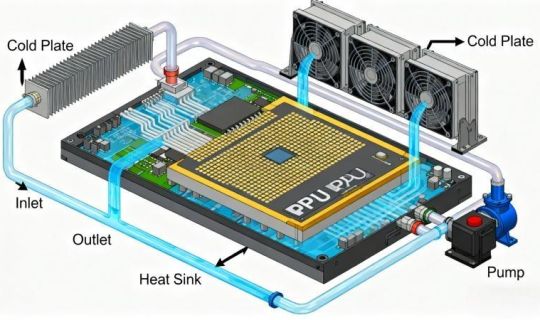
New-build and retrofit projects in 2026 are therefore placing greater emphasis on being “AI-ready.” Typical requirements include high-density racks, liquid-cooling systems, high-speed optical networks, more flexible power-distribution architecture, and facility designs capable of supporting the delivery and phased deployment of large and heavy equipment.
A data center is no longer simply a building that houses servers. It is becoming an integrated infrastructure environment designed and optimized around specific computing architectures from the earliest planning stage.
This transformation also makes project delivery more complex. The installation sequence of liquid-cooling equipment, fiber components, power systems, network switches, and server racks must be precisely coordinated. Delayed deliveries, model substitutions, or cross-border transportation issues can disrupt subsequent installation, integration testing, and commissioning schedules.
For the supply chain, “on-time delivery” is evolving into the ability to deliver according to project milestones, installation sequences, and actual site conditions.
Resource Constraints Enter the Regulatory Framework
As data center development accelerates, its impact on electricity supply, water resources, and public infrastructure is attracting greater regulatory attention.
On July 15, the Australian government announced plans to establish national standards for the next generation of large data centers and to create an artificial intelligence office within the Department of the Prime Minister and Cabinet.
The proposed rules would require large data center operators to fund or secure additional electricity supply, cover the full cost of grid connection, and minimize water consumption. Australian Broadcasting Corporation Report
This policy direction indicates that some markets are shifting from simply encouraging data center investment toward balancing investment with responsibility for resource consumption.
Future project approvals may therefore depend not only on access to land and capital, but also on whether operators can clearly demonstrate their electricity sources, water-management plans, cooling technologies, and overall impact on local public resources.
For multinational data center operators, regulatory differences between countries and regions are also likely to become more pronounced. Some markets may introduce accelerated approval processes to attract AI infrastructure investment, while others may impose stricter requirements relating to energy use, water consumption, carbon emissions, and community impact.
Compliance, resource availability, and social acceptance will therefore need to be incorporated into site-selection assessments much earlier in the planning process.
Implications for the Data Center Supply Chain: Delivery Requires Stronger Project-Based Capabilities
The emergence of gigawatt-scale campuses and high-density AI facilities will directly reshape how servers, switches, optical modules, storage equipment, power systems, and cooling infrastructure are procured, transported, and deployed.
First, equipment delivery will become increasingly phased. Large campuses are typically commissioned by data hall or capacity module, meaning each shipment must be coordinated with construction, rack installation, cabling, testing, and commissioning schedules.
Second, high-value computing and networking equipment requires stronger protection against shock, moisture, and temperature fluctuations, together with enhanced transport security and clear proof of delivery.
Finally, as more equipment moves across borders, importer-of-record arrangements, product certifications, tax structures, export controls, and local last-mile delivery capabilities will need to be considered much earlier in the project lifecycle.
These challenges are even more significant for used and redeployed IT equipment. Equipment condition, serial numbers, model documentation, data-security procedures, and destination-country import requirements may all affect customs clearance and final acceptance by the data center.
International transportation, IOR/EOR services, customs compliance, local warehousing, dedicated-vehicle delivery, site-access appointments, and rack-level deployment must be treated as a continuous process. Only then can companies reduce the risks of customs detention, delivery disruption, and project delays.
Outlook: Scale, Density, and Compliance Will Jointly Determine Project Success
Industry developments in July 2026 show that the global data center sector remains in a period of rapid growth, but the nature of that growth is changing.
Campus capacity is moving toward the gigawatt scale, facility architecture is being redesigned for high-density AI workloads, and governments are beginning to require data center projects to assume clearer responsibility for energy, water, and public infrastructure.
The most competitive future data center projects will require more than land and electricity. They will need reliable equipment supply systems, efficient network and cooling architecture, clearly defined compliance pathways, and strong execution capabilities extending from international transportation to final delivery at the data center.
Conclusion
From large, long-term capacity leases and high-density optical connectivity to tighter resource-use requirements, July’s major data center developments point to a common trend: AI infrastructure development is moving from a race for expansion into a competition based on overall system capabilities.
The next stage of data center development will not simply be about building larger facilities. It will depend on achieving a higher level of coordination across computing, connectivity, energy efficiency, regulatory compliance, and supply chain management.
For companies involved in global data center construction, equipment deployment, and cross-border delivery, understanding these changes in advance will be essential to controlling costs, reducing risk, and ensuring that projects become operational on schedule.